| |
| |
| Bad Ideas |
|
Building a house, as satisfying as it is, is not all fun and games.
Any first time owner-builder will run into a multitude of problems, most of which
could have been avoided with a little bit of experience or getting advice from
the wright person. |
|
| Here's a list of some of my biggest baddest ideas, which have usually
translated into big chunks of either lost time or lost money. |
| |
Not going post and beam
|
|
|
Milling joists and rafters to
save cost  |
|
| Shonky bricks |
|
| Having complicted roof |
|
| Labour |
|
| Misc - few minor problems worthy
of a note |
|
| |
|
|
|
| |
|
|
|
| |
|
Not going post
and beam |
|
| |
|
| |
|
|
| |
Well put it this way.... In 2006, on just Wednesdays, Thursdays
and Fridays (The days I work on my house)... I recorded
53 days of rain!
|
|
|
|
|
| |
Going post and beam, and getting the roof up first (which
isn't that much more expensive anyway), would have freed
up most of those days. |
|
| |
|
|
|
|
|
|
<back to top> |
|
| |
|
|
|
| |
|
Milling joists and rafters to save cost |
|
| |
|
| |
|
|
| |
| At $5.50 a meter, milling joists and rafters seamed
like a good idea. However, the cost for the
whole stack was |
$3500 |
| .... And if you include my loss of income ($1500 after
tax) the stack cost me ......... |
$5000 |
| Now include into that, the cost of paying a labourer
to cut it down to dimensional timber. (I am not even
including the time lost I spent cutting it up) |
$570 |
Now include the cost of buying extra timber....
Mostly due to it being badly measured by the contractor... For the usable width, he gave me the dimension of the widest poit!
I also lost a bit due
to having a massive amount of knots in the middle!
Another source of lose for a few pieces was cracking.
|
$1086
|
| The cost actually comes to ....... |
$6656 |
|
|
|
|
|
| |
The cost actually comes to $6600. Which is actually about
$2100 more than I
could have bought
it already cut and seasoned (And un-knotted) from a timber yard! |
|
| |
|
|
| |
All that isn't to say that milling up small dimensional
timber isn't always more expensive. It's just how it ended
up for me.
Now that I have access to my own mill, coupled with what
I have learnt, I would definitely be able to make it work
out alot cheaper than buying it myself. |
|
| |
|
|
|
|
|
|
<back to top> |
|
| |
|
|
|
| |
|
Ahh, the Bricks |
|
| |
|
| |
|
|
| |
The most time consuming problem I have had on my project
is with my bricks.
I had a contractor make them as load bearing
bricks. Unfortunatly they just weren't up
to scratch
as a load bearing material. Unfortunatly I didn't
know this, until I was almost through putting up my walls.
After finding out, I
had to change my design from load-bearing bricks, to a post-and-beam
construction.
Now either construction method is OK. But to start with
one, then change to another half way through, is about as
time consuming as it gets.
Having to get new (& expensive) materials and learn a
new skill was highly stressful and costly! I can't even begin
to estimate
how much time, money and energy this one cost me!
Listed below where some of the biggest problems I had with
the bricks.......
|
|
| |
|
|
| |
Bad mix and bad curing |
|
| |
I sent a smaple to a mud brick expert who confirmed that the earyh used in the brick was unsuitable for bricks.
Mud brick should be dryed slow... Unfortunatly my brick where dryed in full sunlight in the middle of summer... The contractor said he would hose them down regualy to make it cure slow.... He forgot!
|
|
| |
|
|
| |
Bad pouring tecnique |
|
| |
Most of the bricks where poured in two goes. However the
mix in the two pours sometimes varied in cement content.
And in fact, some pours didn't have cement in them at all.
When a brick is made with inconsistent pours they crack.
Also, as the bricks where made in summer, it ment that half the brick was curing before the next layer was poured!
The picture below shows a brick cracking along the line of
the two pours. |
|
| |
|
|
| |
|
|
| |
|
|
| |
Iron stone in the bricks! My brick maker
thought he wouldn't bother sieving the iron stone out. This
made the bricks
impossible to cut.
To get around this. I had to either make more or do small
poured earth sections. Time, time, time.
Due to some of the chunks of rocks in the bricks being almost
as wide as the brick itself, this made the bricks very weak.
Sometime just lifting it would snap it.
The pics below show some bricks breaking where
the rock is located.
|
|
| |
|
|
| |
|
|
| |
|
|
| |
Craig's tip: Do not listen to contractors who
say it's OK to put large iron-stone rocks in your bricks! |
|
| |
|
|
| |
Varying brick dimensions was another
frustration. They usually varied 30mm in every direction,
quite often
with the top side sloping in one direction or another by
10 degrees.
This made them difficult to lay them consistently. It also
made it difficault to keep my brick layer happy!
|
|
| |
|
|
| |
 |
|
Ben getting grummpy trying to find matching bricks. |
|
|
| |
|
|
| |
Craig's tip: At least keep the height consistent! |
|
| |
|
|
| |
|
|
| |
So far I had to reject over 500 bricks! |
|
| |
|
|
|
|
|
|
<back to top> |
|
| |
|
|
|
| |
|
Having complicted roof |
|
| |
|
| |
|
|
| |
Don't get me wrong. I love my roof, it looks fntastic.
It's just that I chose a very complicted design
for my first roof.
A complicated deisgn means more time. And with little
wood working experience, hiring profesional carpenter
was nesesary.
If I had have stuck with a simple design Icould have
done it all myself, and the time nd lbour saving would
have been over 3k. Easy.
Just by eliminting my Duch Gabels, would have been a
$1000+ saving.
Off course. It's also the same old story... If I had
to build this exact same roof agin, it would be half
the cost and taken about 1/10th the time :) |
|
| |
|
|
| |
|
|
| |
|
|
| |
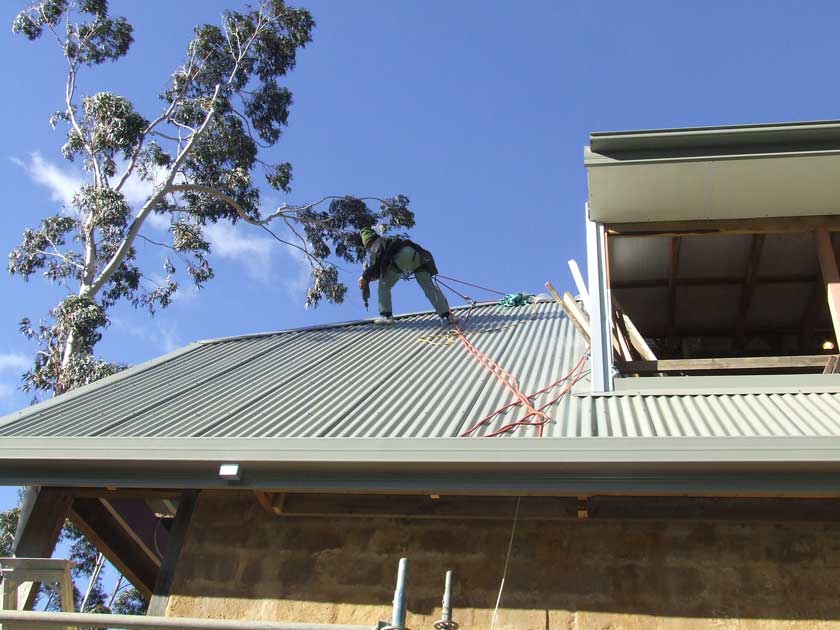
Having a high steep roof ment difficult work positions. |
|
| |
|
|
|
|
|
|
<back to top> |
|
| |
|
|
|
| |
|
Labour inefficiencies |
|
| |
|
| |
|
|
| |
I write this on the 26/7/2007. My job has been going
for over 1 year now, and I have spent about $8000 on labour.
This doesn't seen like much, however when I look at the work done, I could have
cut this buy half. The main reason for the blow-out, is my planning.
By spending the night before deciding what the guy's will be doing, planning
ahead, and , well, just by knowing how to build a house, this cost could have
been easily halved |
|
| |
|
|
| |
Well its now 05/06/2008 nd the labour costs are $23000.
Donig it all agin this would be halved. |
|
| |
|
|
|
|
|
|
<back to top> |
|
| |
|
|
|
| |
|
Misc |
|
| |
|
| |
|
|
|
| |
|
Couldn't think of anywhere else to mention it but here.... |
|
| |
|
A nail gun soooo would have paid for itself. |
|
| |
|
|
|
| |
|
Having a job while I build |
|
| |
|
It's hard to say whether working as an abseiler two days
a week while I'm building a house is a good idea or not.
On the positive side: It's a great source of income financing
my project.
But on the negative side: The job can be quite physically
demanding, leaving me tired and fatiged when it came to my
own project..
And also: Having to plan and
organize another project, for someone else, can also be quite
mentally tiring. |
|
| |
|
|
|
| |
|
BIG bricks |
|
| |
|
I wanted BIG bricks so that I wouldn't have to lay as many,
and the job would go faster... Good idea eh?
The brick size ended up being 380 x 200 x 150, which is
quite big.
What actually happened was, because the bricks where so heavy,
they kept sinking into the mortar. It was very difficult
getting the right runny/stiff ratio to the mortar. So it
ended up taking a bit longer to lay each one. If the bricks
didn't
weigh so much the mortar could have varied a bit.
Oh well,
live and learn 8-) |
|
| |
|
|
|
| |
|
Doing the slab is 3 pours |
|
| |
|
Me and Scott where tossing up whether to do the slab
in 1 big pour or 3 smaller pours. We chose 3 smaller pours
for ease, and I wouldn't need to hassle my boss who was
a formworker...
...Imagine my surprise when we found out that you had to
hire the concrete pump separately at $500 a pop! So doing
3 pours
cost an extra $1000 bucks!
The concret punp dude was very suprised at our decision! |
|
| |
|
|
|
| |
|
Paying someone to sift mortar |
|
| |
|
I thought I would use the sand on my block to make mortar
that would match the colours of my area.
However, sieving out the numerous rock was very time consuming.
So it was a huge saving when I started buying orange sand
at $20 per half tonne!
|
|
| |
|
|
|
|
|
|
| |
| <back to top> |
| |
|
| |
| |
|